
Randomly Rudimentary Faith Stuff
Just some dad trying to leave a footprint for his kids to walk in if they need to know where to go
When Faith Wears a Flag: Why I Can’t Make Sense of Christian Nationalism
As Independence Day rolls around again, I find myself reflecting on the blend of faith and patriotism that often shows up in church pews this time of year.
I’ve sung the songs. I’ve stood for the flag. I’ve even believed, at times, that all of this was simply a way to thank God for our national freedoms.
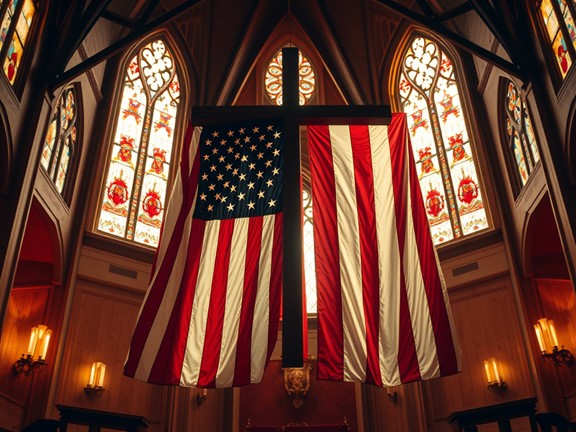
But over the years, something about it has stopped feeling right.
Not because I’m ungrateful. But because I’ve come to believe that faith—and especially the way of Jesus—was never meant to be fused with nationalism.
And every July 4th, that tension gets harder to ignore.
I don’t understand how Christianity and nationalism are supposed to coexist. I know that in America, they often do—loudly and proudly. Many people seem to have no conflict pledging allegiance to both the cross and the flag.
But I also know what happens when religion and national identity get fused too tightly. We’ve seen it before—in Nazi Germany. In apartheid South Africa. And yes, increasingly, here in the United States.
And I’ve felt it firsthand.
Proud to Be an American, Where At Least I Know I’m Better
I’ve been in churches where U.S. national holidays—like Memorial Day and Independence Day—were celebrated in worship services. I’ve sung hymns like America the Beautiful, My Country, ’Tis of Thee, and even The Star-Spangled Banner inside a sanctuary. I’ve sat through renditions of God Bless the USA, complete with standing ovations.
And at the time—especially in my teens and early adulthood—I didn’t think much of it. I saw it as an expression of gratitude. We were simply thanking God, I assumed, for the blessings of living in a free country. But somewhere along the way, something shifted.
Maybe it was the tone. Maybe it was the messaging beneath the music. But I started to sense that we weren’t just thanking God for our blessings—we were thanking God for making us better than others. There was a smugness to it, a barely concealed moral superiority.
I remember one service in particular where God Bless the USA was performed with dramatic flair in service that was boasted as being transmitted to a sister congregation somewhere in Burundi. As the soloist belted out, “I’m proud to be an American, where at least I know I’m free,” I looked around and wondered:
What about the people from Burundi who are Christians and who might be hearing this?
What does it feel like to sit in a church and hear Christians equating God’s blessing with their national identity?
And more importantly: is that what Jesus would want?
Hey, Burundians, get to ‘Murica as quick as you can!
No, wait! We don’t want you!
Is that the message he embodied—gratitude for political dominance, pride in moral exceptionalism, victory over others? Or was his message something altogether different—radical humility, borderless compassion, and a love that refused to be limited by flags?
Unsettling Cracks in the Dam
When I started to realize these things, I didn’t immediately run away from the religion I’d grown up with. I didn’t walk out of church or renounce my faith in some dramatic moment.
But looking back now, I think those were the first cracks in the dam—the quiet internal tremors that eventually pushed me away from a nationalistic pseudo-worship that had more to do with preserving power than following Jesus. Because here’s the thing: the more I looked at the teachings of Jesus, the less I could reconcile them with the culture I saw around me.
How can a faith built on humility, love for enemies, and radical inclusion be twisted into something that demands moral or national superiority?
I’m not asking that as a cynic or a political contrarian. I’m asking as someone who is still deeply moved by the life and words of Jesus—but increasingly unsettled by the way his name gets used to prop up a particular version of America.
The Root System of Bad Fruit
There’s a part of me that believes some of this is rooted in theology. Specifically, in strands of Calvinism that place heavy emphasis on being among the “elect”—those chosen by God for salvation.
Over time, I think that idea can start to morph. Not just saved, but special. Not just blessed, but better. More moral. More deserving. More right.
And once you start believing that—once you see yourself as chosen in a way others are not—it’s not a huge leap to start building systems that protect your position, justify your dominance, and baptize your politics.
But that’s not the gospel I see when I look at Jesus.
- He didn’t build walls. He crossed them.
- He didn’t cozy up to power. He confronted it.
- He didn’t wrap his message in the colors of any empire’s flag.
If anything, his message threatened those flags. “My kingdom is not of this world,” he said. And yet somehow we keep trying to force it into one.
And I think that same attitude fueled something else I grew up around: the American evangelical missionary movement.
I was raised among people who genuinely believed we needed to take Jesus “to the uttermost parts of the world”—but it wasn’t always about bringing hope or healing. It was often about bringing our version of Jesus. The one dressed in Western clothing. The one who looked like us, voted like us, and lived like us.
Too often, the real goal wasn’t ministry—it was subtle superiority. It was about showing people in faraway places how the American way of life was better than theirs. Christianity was the costume. Culture was the agenda. And somewhere in that mix, the actual gospel got lost.
This attitude showed up clearly whenever missionaries returned from the “foreign field” for church services or denominational conferences. They’d present slideshows of the “less fortunate” people they were ministering to—families living in huts, children without American-style clothing.
And we were told that our financial contributions would help those people not just know Jesus, but learn how to live and dress like us. Like civilized people.
To be clear, I believe deeply in the good work being done by those who travel to remote communities today to dig wells, provide access to clean water, or offer medical care. Many of those people are motivated by their faith. But they don’t go to impose a particular theology or win converts to a specific doctrine. They go to serve. To meet needs. To lift others up, not themselves.
That, to me, is very different from the evangelical missionary model I grew up with. And maybe it’s changed—I honestly don’t know anymore. I’m not part of that world these days. But I know what I saw back then, and I know how it made me feel.
Ashamed. Conflicted. And eventually, disillusioned.
Faith or Flag?
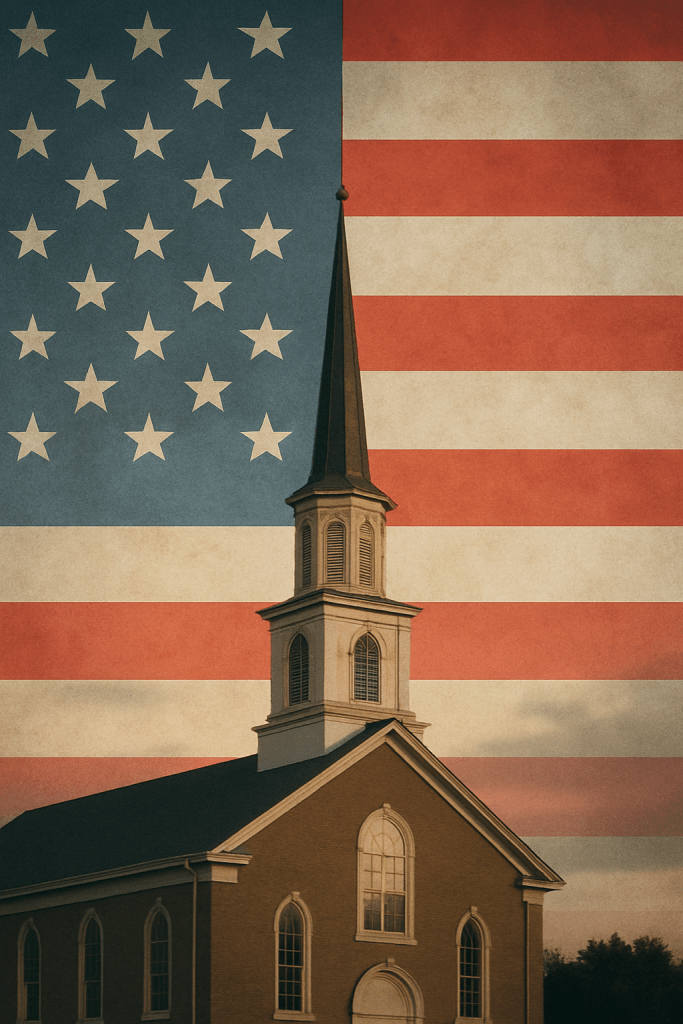
I know there are people who see no problem with blending patriotism and faith. They believe America has been uniquely blessed by God and that defending its ideals is part of defending the gospel itself.
But I just can’t see it that way anymore.
The more I try to follow Jesus, the harder it is for me to reconcile that kind of thinking. Because everything about Jesus points away from systems of dominance and toward radical humility.
He never spoke about making his homeland great again. He never pointed to political power as the pathway to righteousness. He didn’t tell his followers to conquer the world in his name. He told them to love it—even when it hated them.
How Could You?
That’s why I can’t make sense of Christian nationalism. Because Christianity wasn’t supposed to be a tribe. Or a country. Or a campaign. It was supposed to be a way of life that looks like love. A kingdom that doesn’t belong to any one nation, but welcomes people from every single one.
So if you’ve ever felt uneasy about churches wrapped in flags, or sermons that sound more like stump speeches than sacred calls to compassion—you’re not crazy. You’re not ungrateful. And you’re not alone.
You’re just someone who senses that Jesus never asked for our national allegiance. He asked for something harder, and more beautiful.
He asked people to follow him.
So as fireworks go off and flags fly this weekend, I’m not here to dampen anyone’s celebration. But I am inviting a different kind of reflection—one that asks whether the Jesus you claim to follow ever asked for national loyalty in the first place.
He didn’t need a country to change the world. He only needed people willing to love beyond borders.
That’s the kind of freedom I’m still learning to believe in.
Grace and grit to you! — LK
 Randomly Rudimentary Faith Stuff