
Randomly Rudimentary Faith Stuff
Just some dad trying to leave a footprint for his kids to walk in if they need to know where to go
What Carrots, Spinach, and the Rapture Have in Common
By LONNIE KING
There are a couple of things I “knew” growing up that turned out to be…let’s call them confidently overstated.
- Carrots improve your eyesight.
- Spinach makes you stronger.
Those weren’t presented as opinions. They were facts. Settled science. Delivered with the kind of confidence that makes a kid stop asking questions.
And the people telling me? They believed it.
Not necessarily because they were gullible. Not because they were careless. But because that’s what they had been told.
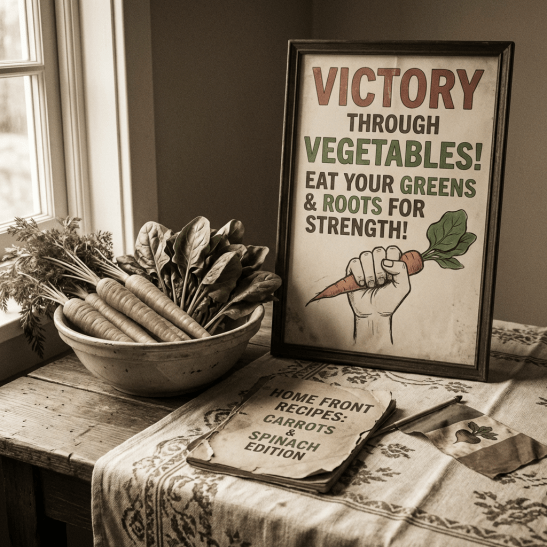
My parents would’ve learned those things as kids themselves—coming of age in a world shaped by World War II messaging and post-war culture. By the time it got to me, it wasn’t propaganda or pop culture anymore.
It was just…true.
When a Story Becomes “Truth”
The carrot thing, as it turns out, traces back to World War II. The British needed a cover story for new radar technology, as well as a food supply shortage. Carrots were easy to grow and a surplus was available, so they credited their pilots’ success to eating the vegetable and, in turn, encouraged the general population to follow suit.
It worked so well that it outlived the war.
The spinach thing? It was popularized by Popeye the Sailor—yes…the cartoon character who transformed from a bullied weakling to a superhuman strongman when he ate a can of the leafy green veggie. That characterization became cultural shorthand for strength that stuck long after anyone checked the actual science.
In both cases, something partially true got turned into something universally true.
And once that happens, it spreads. Not because it’s accurate—but because it’s useful. Memorable. Repeatable. And eventually… unquestioned.
That Same Pattern Shows Up in Religion
Here’s where this gets a little closer to home: there are beliefs many of us were taught in church with that same level of certainty. Not as interpretations. Not as theological frameworks.
As facts.
One of the biggest examples? The idea of the Rapture.
For a lot of us, it was presented as if it had always been a central part of Christianity—right there alongside the resurrection and the teachings of Jesus.
But historically, that’s just not the case.
The modern concept of the Rapture—as a sudden event where believers are taken up and unbelievers are left behind—didn’t take shape until the 19th century, largely through the teachings of John Nelson Darby. It gained traction through study Bibles, prophecy conferences, and eventually mainstream Christian culture.
If you grew up reading Chick tracts or Left Behind, you know exactly how real it was made to feel.
How It Becomes “What the Bible Says”
And here’s the part that’s easy to miss: once an idea is repeated often enough—preached with confidence—and reinforced by books, sermons, and community, it stops being “a way of interpreting Scripture” and starts being “what the Bible clearly teaches.”
Even if the historical roots are relatively recent. Even if Christians for most of history didn’t hold that view.
It’s not that people are trying to mislead anyone. It’s that we inherit beliefs the same way we inherited the carrot story. From people we trust. In environments where questioning feels unnecessary—or even unwelcome.
When Interpretation Turns Into Justification
Let me be clear about something, because this matters: my issue is not with interpretation.
Everyone who reads the Bible is interpreting it. Every pastor, every teacher, every believer—we all bring our own lenses, experiences, and understanding to the text. And naturally, we seek out voices we trust. People we believe have studied more, lived more, or understand more.
So, disagreement? That’s not the problem. Different perspectives? That’s not the problem either.
The Problem Is When Interpretation Becomes Weaponized
Where I start to have a problem is when an interpretation stops being presented as a way of understanding and starts being wielded as absolute truth that demands action.
Because at that point, it’s no longer just theology. It’s influence. It’s power. And sometimes, it’s justification for ungodly things.
When Theology Starts Driving Policy
We’re seeing that play out right now. There are Christian voices—politicians, pundits, and preachers—framing conflict in the Middle East not just as geopolitics, but as prophecy unfolding in real time.
Specifically, rhetoric surrounding Iran.
I’ve seen and heard claims that military action, escalation, even outright war is somehow aligned with God’s plan—that it’s helping bring about the conditions for the “end times” and ultimately, the Rapture.
Sit with that for a second.
That’s not just interpretation anymore. That’s taking a relatively modern theological framework and using it to make sense of, or even endorse, the destruction of a sovereign nation and the loss of human life.
Where This Stops Being Theoretical
This is the moment where a belief crosses a line. Because when an interpretation encourages indifference to suffering, frames war as spiritually necessary or suggests that destruction is somehow part of a divine timetable, it stops being a harmless difference of opinion.
It becomes dangerous.
Not because people are trying to be dangerous—but because the belief itself carries consequences.
Faith Shouldn’t Require Us to Cheer for Destruction
I can respect someone saying, “This is how I understand Scripture.” I can even respect, “I believe this is pointing toward something bigger.”
But I struggle deeply with, “This war is good because it moves us closer to what the Bible teaches is the end.”
Because whatever else we believe about prophecy, we’re still talking about real people. Families. Children. Lives that don’t fit neatly into anyone’s theological timeline. Lives that should be important to the God these people claim to worship and heed. And, by extension, should be important to them.
Why the Origin of Ideas Matters
And this brings me back to carrots. And spinach. And all the things we inherit without questioning.
Because when something is presented as “this is just what the Bible says,” without acknowledging where that interpretation came from, how recent it is, or how debated it’s been, we lose the ability to evaluate it responsibly.
And when that belief starts influencing how we view war, policy, or human life?
That’s not a small issue anymore.
Maybe the Better Question Isn’t “Is This True?”
The older I get, the less interested I am in defending everything I was taught and the more interested I am in understanding it.
Not tearing it down for the sake of it—but being honest about where it came from. Because if something is true, it can handle being examined. And if it can’t, maybe it was never as solid as we thought.
So maybe the better question isn’t just:
“Is this belief right or wrong?”
But:
What does this belief lead us to become?
More compassionate? More thoughtful? More aware of the weight of human life? Or more willing to accept—or even celebrate—things that should break our hearts?
Grace and grit to you! — LK
 Randomly Rudimentary Faith Stuff