
Randomly Rudimentary Faith Stuff
Just some dad trying to leave a footprint for his kids to walk in if they need to know where to go
When the Bible Doesn’t Sound Like It Agrees with Itself
By LONNIE KING
I’m going to say something out loud that I’ve spent a long time trying not to think too hard about:
Somewhere along the way, I came to the conclusion that the Bible isn’t the single, unified voice I was taught to believe it was.
That realization didn’t happen all at once. It took time. Questions. A few uncomfortable moments where what I was reading didn’t quite line up with what I’d always been told it meant.
And if I’m being honest, part of me resisted that conclusion for a long time—because once you see tension in something you were taught was seamless, it’s hard to unsee it.
That realization probably makes some people who have known me for a long time uncomfortable. It used to make me uncomfortable too.
Because for most of my life, I was taught that Scripture is univocal—that from Genesis to Revelation, it speaks with one consistent message, one consistent tone, one consistent truth. If something appeared to contradict, the problem wasn’t the text. It was me.
So, I learned how to resolve tensions. Or maybe more honestly… I learned how to smooth them over.
Where the Tension Started Feeling Real
Lately, I’ve been sitting with something I can’t quite smooth over anymore:

Sometimes, Paul doesn’t sound like Jesus.
That’s not a knock on Paul. It’s just an observation. And it’s one that feels important to acknowledge—especially because of how much of the New Testament is attributed to him.
Paul is often credited with writing a significant portion of what we now consider Scripture. I’m not enough of a scholar to debate the exact scope of that, but it’s clear his voice carries a lot of weight in how Christianity has been shaped and taught.
And because of that, I think it matters to say this out loud:
Paul was not Jesus.
Which means that if we’re going to talk about the Bible as a unified voice, we have to at least be honest about the fact that much of that voice is coming through one very passionate, very human person trying to apply what he believed about Jesus to real situations in real communities.
When I read Jesus in the Gospels, I see someone who:
- moves toward people who are pushed away
- restores dignity before demanding change
- challenges hypocrisy more than personal failure
Then I read some of Paul’s letters, and at times I hear:
- correction
- instruction
- boundaries that feel sharper
A specific example that’s been sticking with me is Paul’s instruction to the church in Corinth to remove a man from their community because of a relationship he was in. Later, Paul tells them to forgive and restore him—but that part doesn’t seem to get nearly as much attention today.
And I find myself wondering: why do many Christians emphasize the removal, but not the restoration?
The Question I Can’t Shake
Here’s where my thinking has been shifting.
What if the issue isn’t, “Is the Bible true or not?” But rather, “Are we being honest about how we read it?”
Because when I look at how Scripture is actually taught in many spaces, it doesn’t feel like all passages are treated equally—even in communities that insist they are.
Some verses get highlighted. Some get explained away. Some quietly fade into the background.
And if I’m being honest, I’ve done the same thing.
What If Paul Was…merely Human?
This is where things get a little more personal for me.
Paul was passionate. Driven. Intense. Even before his conversion, he was known for being forceful and certain.
And I’ve started to wonder: What if his personality didn’t really disappear or change when he became a follower of Jesus?
What if that drive, intensity and near certainty that he was doing the right thing was redirected—but still present?
That doesn’t make his words meaningless. But, they may not be divine either.
It might mean the thoughts and instructions he conveyed not detached from his humanity, too. And, as such, maybe they shouldn’t carry the same weight with people who claim to follow Jesus as Jesus’ own teachings do?
And if that’s true, then maybe reading Paul requires more than just quoting him. Maybe it requires understanding him.
Would Jesus Have Said It Differently?
How would Jesus have dealt with some of the issues his growing flock of followers faced, if he had physically been present in the first century after his death? I don’t know the answer to that question.
But I do know this: when I imagine Jesus speaking into the same situations Paul addressed, I picture:
- more questions
- more stories
- more emphasis on the heart behind the behavior
Not less truth. Just…a different delivery. And maybe a different impact. Maybe, even, spawning a different religion altogether?
What I’m Learning to Admit
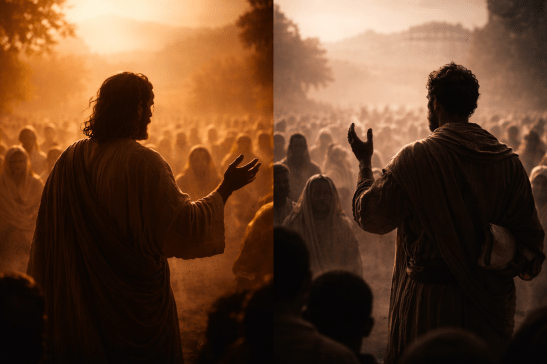
Here’s the part I’m still working through: I think a lot of people say they believe the whole Bible…but in practice, they lean on the parts that fit their theology—or politics—but quietly ignore the parts that complicate it.
That’s not just an “evangelical problem.” That’s a human problem. And I’m trying—really trying—not to do that anymore.
Also—and this was a big deal for me to acknowledge—multitudes of Jesus who claim to follow Jesus are actually disciples of Paul.
If that lands as heresy when you read it, imagine how it must feel to write it. But that’s what I think right now.
Where This Leaves Me
I don’t have this all figured out. But, I’m also not trying to tear anything down for the sake of it. I’m just trying to be honest about what I see—and what I don’t fully understand.
Is this religion we call Christianity today nothing more than a Pauline Cult?
But, what I do keep coming back to is this: if Jesus said the greatest commandments are to love God and love others, and that those two things can’t be separated…then any way I interpret Scripture has to be measured against that.
Not perfectly. Not arrogantly. But honestly. Even if that honest assessment results in the conclusion that maybe some of what Paul, or anyone else, wrote (that was later treated as sacred) might never have been intended to become the foundation of a faith.
An Open Hand Instead of a Closed Fist
Maybe that’s what this season is about for me: holding my beliefs with an open hand instead of a closed fist.
Being willing to say:
- “I might not have understood this correctly before”
- “I might still be wrong now”
- “But I care enough to keep asking”
And maybe that’s the invitation I’d extend to anyone reading this. Not to agree with me, but to be willing to sit with the tension instead of rushing to resolve it.
I don’t make that invitation lightly. And I’m not asking anyone to throw away everything they’ve always believed. I just don’t believe anymore that God takes pleasure in the certainty of our belief systems.
I think He takes pleasure in our willingness to keep asking questions…and in our desire to wrestle with whether what we’ve been taught is actually true. Because sometimes growth doesn’t come from having better answers. Sometimes it comes from finally asking better questions
 Randomly Rudimentary Faith Stuff