
Randomly Rudimentary Life Stuff
Learning to live authentically, and not settling for substitutes or counterfeits, and sharing those thoughts
The Hidden Stories of the Movies I Never Saw
By LONNIE KING
I recently stumbled across one of those online articles listing the biggest movie from every year in history. I hoped I might find something that would trigger fond memories and make me wax nostalgic in a profound way.
But a stranger thing happened, as it often does when I try to find blog fodder.
According to the article, the biggest movie the year I was born — 1961 — was West Side Story. The funny thing is, I’ve never really cared much about West Side Story. Gangs of dancing hoodlums on the streets of New York—who also sang really well—never struck a nerve with me.
And it’s not that I hate movie musicals. I actually enjoy some of them. (Grease is the WORD!) But that one never really connected with me. So, disappointed that the biggest box office success of my birth year wasn’t doing the trick, I started looking at the other major movies from 1961—thinking maybe something else would spark recognition or nostalgia.
Instead, I realized something surprising: I barely know most of those movies at all.
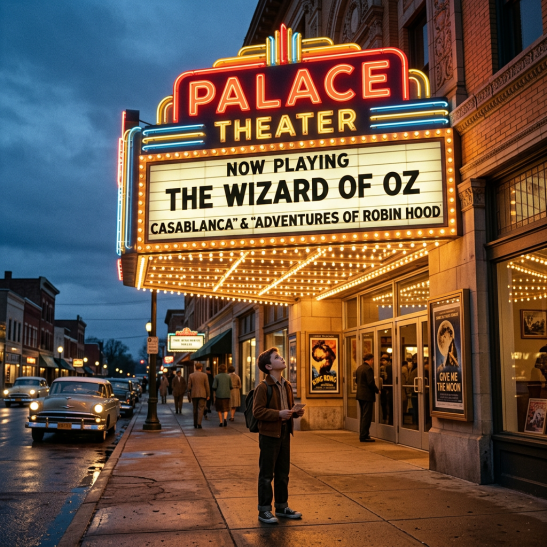
Sure, I recognized a few titles. I knew the Disney films like One Hundred and One Dalmatians and The Parent Trap. I remembered Audrey Hepburn being beautiful in Breakfast at Tiffany’s, even as a kid seeing clips years later. I vaguely remembered watching The Hustler at some point long after it came out, though I honestly don’t remember much about it now.
But movies like The Misfits, Splendor in the Grass, or A Raisin in the Sun?
Practically strangers to me.
And the more I thought about it, the more I realized that probably says less about Hollywood and more about the atmosphere I grew up in.
Raised on “Wholesome”
Don’t misunderstand me: I would not have known any movie in 1961, or the next handful of years. But, even after those movies were relegated to Saturday night movie status on TV, I still never came across them.
I know now, that was a curated decision because, in our house, movies weren’t just entertainment. Entertainment carried moral weight.
I don’t remember my parents constantly issuing dramatic speeches about “worldly Hollywood,” but there was an understanding that hung in the air: if a movie did not ultimately promote good Christian values, it was suspect. Maybe even dangerous.
The goal of entertainment wasn’t simply to tell honest stories about life. The goal was to reinforce a moral framework.
Good people were clearly good. Bad people were clearly bad. Families were stable. Authority figures deserved respect. And the world eventually resolved into something orderly and wholesome.
Disney movies usually fit beautifully into that ecosystem.
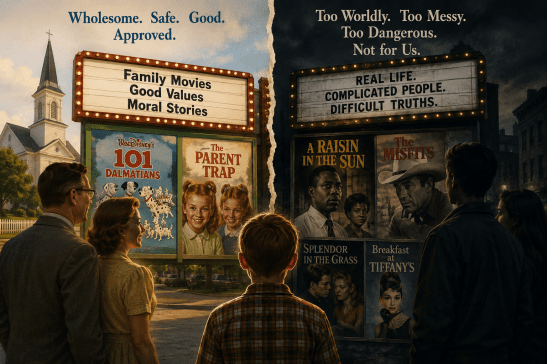
But emotionally messy movies? Morally complicated movies? Stories about brokenness, loneliness, sexuality, racism, disappointment, or rebellion? Those tended to live outside the approved boundaries. And it wasn’t necessarily because anyone sat me down and explicitly banned them.
Sometimes cultural filtering works more quietly than that.
Some stories are recommended. Others are ignored. And eventually you absorb the message that certain stories simply are not “for people like us.”
The Stories Outside Our World
I was oblivious to it for a long time, but segregation was still a major reality when I was born in Houston in 1961. Houston was growing and changing, but the culture surrounding me was still deeply shaped by Southern conservatism and conservative Christianity.
My parents were not overtly hateful people. But they came from a world where many Christians sincerely believed there were even biblical grounds for racial separation.
That sounds jarring now, but it was not uncommon in certain churches and households at the time.
So, a Sidney Poitier film like A Raisin in the Sun was never likely to become part of our family’s cultural vocabulary. Not because someone delivered a racist manifesto at the dinner table. More because certain stories simply existed outside what was considered “our world.”
Looking back now, that realization feels more sad than shocking.
Because what strikes me today is how many of those films were not actually promoting immorality at all. They were simply acknowledging reality.
- Real people.
- Real struggles.
- Real loneliness.
- Real injustice.
- Real confusion.
And in the version of Christianity I grew up around, even acknowledging certain realities could itself feel spiritually threatening.
The Devil Went to the Movies
That mindset did not magically disappear by the time I became a teenager.
When Animal House came out, I took a girl to see it without telling my parents. Now, let me be clear: I was old enough to drive, but far too socially awkward and naïve to have some grand immoral scheme in mind. I just wanted to see the movie because everybody was talking about it.
But, when my dad eventually found out, he expressed strong disappointment in me.
Not because I had mistreated the girl. Not because I had behaved irresponsibly. Not because I had done anything physically inappropriate.
He was upset because I had exposed her to something morally polluting.
That was the framework: entertainment itself could corrupt the soul.
And honestly, I understand where that fear came from now better than I did back then. My parents genuinely believed they were protecting people from spiritual harm.
But it’s also funny to me now that Animal House eventually became one of my all-time favorite movies. Not because it’s some profound masterpiece of moral philosophy. But because beneath all the chaos and stupidity, there was something liberating about watching a movie that refused to maintain the illusion of perfection.
Revisiting the Stories
The older I get, the more interested I become in the stories I missed the first time around.
Not out of rebellion anymore. Not because I’m trying to shock anyone. But because I’ve realized how carefully curated my emotional and cultural world was growing up.
The movies we watched. The movies we avoided. The stories considered wholesome. The stories considered dangerous. All of it shaped how we understood people, morality, race, faith, authority, and even ourselves.
Sometimes when I finally watch one of those older films now — a movie that was considered too worldly, too messy, or too morally complicated back then — I find myself wondering how I might have processed it if I had seen it at the age it originally appeared.
Would it have changed anything about me? Would it have expanded my worldview earlier? Would it simply have confused me?
Honestly, I don’t know.
But I do know this: the person I became was shaped not only by what I saw growing up, but also by what I didn’t see.
By the stories filtered out. The conversations avoided. The realities softened or ignored. And sometimes when I think back on those things now, it makes me sad.
Because there were probably real people hurting all around me while I was growing up. People wrestling with loneliness, depression, racism, abuse, doubt, addiction, fear and identity.
And I’m not sure I would have known how to help them. Worse than that, I’m not even sure I would have understood why I should help them. Because when you grow up believing the world is divided neatly into “good influences” and “bad influences,” it becomes very easy to mistake struggling people for dangerous ideas.
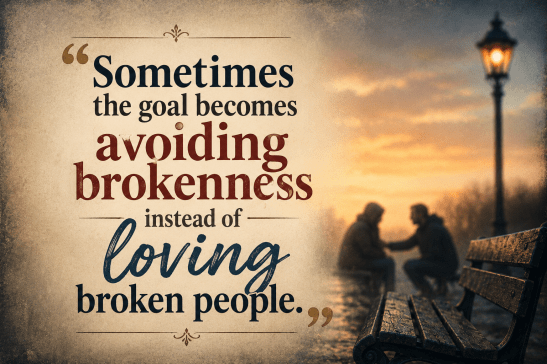
When that happens, sometimes the goal becomes avoiding brokenness instead of loving broken people.
I don’t say that to shame my parents or the world they came from. They genuinely believed they were protecting us. But looking back now, I think some of the stories we avoided were actually invitations to empathy.
Not celebrations of sin. Not attacks on morality. Just reminders that human beings are complicated and often hurting in ways that aren’t visible on the surface.
Culture forms us that way sometimes — not only through exposure, but through absence.
And maybe part of growing older is realizing that honest stories about flawed human beings were never really the enemy.
Maybe they were simply telling the truth about life before some of us were ready to hear it.
Grace and grit to you! –LK
 Randomly Rudimentary Life Stuff